Summary
Vehicle exhaust contains multiple toxic pollutants, including carbon monoxide, benzene, and nitrogen dioxide, that can reach dangerous concentrations within minutes in an enclosed shop. This guide explains why dedicated exhaust removal systems are essential, how the three main system types compare, what features to prioritize when selecting one, and how to keep it performing over time.
Why vehicle exhaust is a serious workplace hazard
Technicians who work near vehicles running at or above idle are continuously exposed to combustion byproducts released through the tailpipe and engine bay. These emissions are not merely unpleasant, many are acutely toxic or classified as known human carcinogens.
Key pollutants found in vehicle exhaust include:
Carbon monoxide (CO)
Colorless and odorless, CO interferes with oxygen delivery in the blood, causing dizziness, unconsciousness, and death at high concentrations. It cannot be filtered and is the leading cause of CO exposure in the U.S.
Nitrogen dioxide (NO₂)
Irritates the airways and increases susceptibility to respiratory infections with repeated exposure.
Benzene and formaldehyde
Classified carcinogens linked to leukemia and other cancers through chronic low-level exposure.
Particulate matter (PM)
Fine particles penetrate deep into lung tissue, contributing to asthma, cardiovascular disease, and long-term respiratory decline.
Sulfur dioxide and ozone
Secondary irritants that exacerbate existing respiratory conditions.
Vehicles idling indoors can generate exhaust temperatures up to 600°F, accelerating the rate at which contaminants disperse into the surrounding air. Because CO and several other compounds are invisible and odorless, overexposure can occur before any warning signs are noticed.
Why ventilation alone is not enough
General ventilation — fans, open doors, HVAC systems — dilutes exhaust by mixing it with larger volumes of air. While this reduces peak concentrations, it does not eliminate exposure risk. Diluted but persistent pollutant levels can still exceed occupational exposure limits over the course of a shift.
Exhaust removal systems work differently: they capture emissions directly at the source, the tailpipe, before contaminants enter the ambient air. Source-capture is the only method that reliably eliminates the exposure pathway rather than simply reducing it.
OSHA and industrial hygiene guidance consistently identifies source-capture exhaust extraction as the preferred engineering control for vehicle exhaust in enclosed spaces. Ventilation is considered a supplementary measure, not a primary solution.
Types of Exhaust Removal Systems
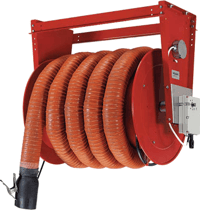
Hose Reels
Hose reels are among the most convenient solutions for vehicle exhaust removal. They are available in manual spring-operated and motor-operated variants.
-
-
-
-
- ✓ Manual spring-operated reels are ideal for applications where the hose reel is within reaching distance of the operator, making them user-friendly and straightforward to use.
-
-
-
✓ Motorized hose reels are better suited for environments where the hose reel is beyond the reach of the operator or when a larger diameter hose is required. These can be fitted to a remote control or wall switch, offering increased flexibility and ease of operation.
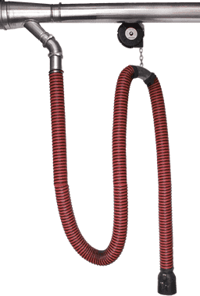 Overhead Systems
Overhead exhaust removal systems are versatile and highly effective. They come in two main variations: rope and pulley, and spring balancer systems.
These systems can accommodate various hose types, ranging from high-temperature silicone to medium-temperature polyester.
Overhead systems connect to ductwork and central fans, ensuring comprehensive exhaust removal. For stand-alone setups, direct mount fans can be utilized to enhance efficiency.
The flexibility in hose types and lifting configurations makes overhead systems suitable for a wide range of applications, ensuring optimal performance in different settings.
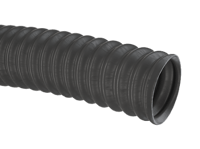 Crushproof Exhaust Hoses
Crushproof exhaust hoses are the most cost-efficient method for extracting exhaust fumes from vehicles, especially those that run at or higher than idle indoors.
These hoses are designed to retain their form even after being repeatedly driven over or stepped on, making them a durable and long-term investment.
Crushproof hoses are particularly useful in garages where vehicles are close to the ventilation system, providing an easy and effective solution for maintaining air quality.
Applications that require exhaust removal
Exhaust removal is not limited to standard passenger car service bays. Any facility where combustion engines operate indoors should have a system in place, including:
| Cars & Light Trucks Semi Trucks Military Dyno Motorcycle & ATV Generators |
General Ventilation Diesel Exhaust Fire/ Emergency Vehicles Bus Tractors Small Engine |
Key features to evaluate when selecting a system
Source-capture efficiency
The system should attach directly to the tailpipe and draw exhaust outside the building before it disperses.
Hose temperature rating
Match the hose material to your application. High-temperature silicone hoses are required for diesel or high-idle testing environments.
Hose durability and flexibility
Hoses must withstand repeated use, vehicle contact, and shop floor conditions without cracking or collapsing.
Ease of operation
Systems that require significant manual effort are more likely to be skipped under time pressure. Motorized reels and spring-balancer overhead systems minimize friction.
Infrastructure compatibility
Verify that new systems integrate with existing ductwork, fan capacity, and electrical supply.
Scalability
Consider future bay additions or vehicle type changes when sizing fans and ductwork.
Benefits of installing an exhaust removal system
- Eliminates technician exposure to CO, carcinogens, and fine particulate matter
- Reduces sick days, absenteeism, and long-term occupational illness risk
- Improves technician morale and productivity in a cleaner work environment
- Demonstrates a documented commitment to worker safety — valuable for recruiting and retention
- Supports OSHA compliance and reduces liability exposure
How to choose the right system for your shop
The right system depends on three primary factors: the size of your facility, the number of active bays, and the types of vehicles serviced.
Single-bay or small shop
A crushproof hose or manual hose reel typically provides adequate source capture at the lowest upfront cost.
Multi-bay facility
Overhead systems connected to centralized ductwork offer the best coverage and operational consistency across bays.
High-volume or mixed-fleet shops
Motorized hose reels or overhead systems with dedicated fans per bay provide the flexibility to handle passenger cars, trucks, and diesel equipment simultaneously.
Consulting with a specialist before purchase is recommended. A qualified representative can assess bay layout, vehicle mix, and existing ventilation infrastructure to recommend a configuration that meets OSHA requirements and accommodates future growth.
OSHA compliance and regulatory requirements
The Occupational Safety and Health Act of 1970 requires employers to provide working conditions free of known hazards. Vehicle exhaust in enclosed spaces is a recognized hazard under OSHA's General Duty Clause, and OSHA has established permissible exposure limits (PELs) for CO, NO₂, benzene, and formaldehyde.
Failure to implement adequate exhaust controls can result in citations, fines, and increased workers' compensation liability. Effective exhaust removal systems are the primary engineering control OSHA recommends for vehicle service environments.
Maintenance tips for long-term performance
- Inspect hoses and connectors monthly for cracks, wear, or leaks — replace damaged sections immediately.
- Clean hoses, ducts, and fans quarterly to remove accumulated soot and debris that restrict airflow.
- Replace filters on schedule per manufacturer guidance to maintain air quality downstream.
- Lubricate reel mechanisms and pulleys per the service interval to prevent binding and extend service life.
- Document all inspections and maintenance — written records support OSHA compliance audits.
FAQs: Vehicle Exhaust Removal
What makes carbon monoxide particularly dangerous in a repair shop?
CO is colorless and odorless, so there is no sensory warning before concentrations become dangerous. In an enclosed shop, idling vehicles can bring CO to hazardous levels within minutes. Because it binds to hemoglobin more readily than oxygen, even moderate overexposure causes cognitive impairment and, at higher levels, loss of consciousness or death.
Is opening the garage door sufficient to protect technicians from exhaust?
No. Open doors improve general dilution but do not reliably prevent localized buildup near the vehicle's tailpipe. Wind direction, bay layout, and the number of running vehicles all affect how effectively open doors clear the air. Source-capture exhaust removal is the only method that consistently eliminates the exposure pathway.
Does OSHA require vehicle exhaust removal systems?
OSHA does not mandate a specific product, but the General Duty Clause requires employers to eliminate recognized hazards. Because vehicle exhaust in enclosed spaces is a well-documented hazard with established PELs for CO, benzene, and other components, OSHA inspectors routinely cite facilities that lack adequate source-capture controls. Installing a certified exhaust removal system is the standard method of demonstrating compliance.
What type of exhaust removal system is best for a diesel fleet maintenance facility?
Diesel exhaust requires hoses rated for higher temperatures and particulate loads than standard gasoline exhaust. Overhead systems with high-temperature silicone hoses and dedicated fans are generally the best fit for diesel fleet environments. For large multi-bay facilities, a centralized ductwork system with individual drop points per bay provides the most consistent performance.
How often should exhaust removal system hoses be replaced?
There is no universal replacement interval — it depends on usage frequency, hose material, and the temperatures involved. Inspect hoses at least monthly for cracking, stiffening, or connector wear. Crushproof hoses used in high-traffic bays (driven over frequently) may need replacement sooner than overhead hoses. Follow the manufacturer's recommended service intervals as a baseline.
Can one exhaust removal system serve multiple bays?
Yes. Centralized overhead systems connect multiple hose drop points to shared ductwork and a central fan. The fan must be properly sized to maintain adequate capture velocity across all active drops simultaneously. A specialist can calculate the required CFM (cubic feet per minute) based on the number of bays and expected simultaneous use.
What is the difference between a spring-operated and motorized hose reel?
Spring-operated reels retract automatically when the hose is released and are ideal when the reel is within easy reach of the technician. Motorized reels are better suited for ceiling-mounted installations or large-diameter hoses where the tension required for manual retraction would be excessive. Motorized units can be controlled via wall switch or remote, improving convenience in busy bays.